
project:runaikal:scratchpad
Table of Contents
Runaikål Project Documentation
 This page is a draft for the main project page
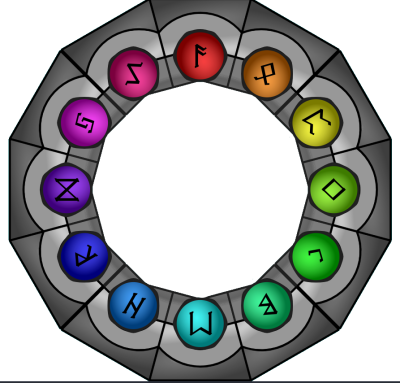
This project covers the development of MangoTrain's Runaikål, a 12-tone circular instrument utilising electronic synthesis and physical resonance to achieve a Shepard tone effect.
An interactive demo can be found here: [ Demo | Source Code ]
Hardware Specifications
Core Components
| Component | Specification |
|---|---|
| Microcontroller | ATMega328 (chosen over ATTiny45 for scaling and pin count) |
| Power | 2x AA Rechargeable batteries |
| Output | 4x Piezo buzzers (2 per chip) |
| Amplification | TL072 Op-amp with RC circuit and relay |
| Input | Contact button located in the “Gem” |
Circuitry & Power Management
- Signal Path: PWM Output → RC Circuit/TL072 (Sine conversion) → Piezo Buzzers.
- Energy Saving: * The chip enters Sleep Mode immediately after all note tails have faded.
- Relay Switch: A dedicated “waker” pin triggers a relay to connect the battery to the op-amp only when the chip is active.
- Current Issues: * Volume is insufficient on AA battery power.
- Potential need for capacitor boosting to increase rounding and volume.
Software & Sound Logic
Synthesis Principle
- Shepard Tone: The chip produces three simultaneous sinusoidal frequencies.
- Higher harmonics decrease in amplitude as the scale ascends.
- Lower harmonics increase in amplitude as the scale ascends.
- Result: A “circular” or “donut-like” soundscape.
- Dynamics: * Variable Decay: Sound fades based on contact duration.
- Muting Simulation: Longer contact increases decay speed to simulate a percussive “mute.”
- Processing: PWM values are processed off-cycle upon a flag to ensure timing delivery is prioritized.
Tuning Compromise
- Perfect 5ths: 6 of the 12 tones are shifted just enough to allow half of the notes to be in perfect 5ths with the other half.
- Timbre: Current sound is described as “Grüüüüm.” Needs further “softening” to move away from a harsh electronic tone toward a more organic “cave” sound.
Physical Design & Manufacturing
Case & Aesthetics
- Geometry: The design is based on a truncated dodecagon.
- The Gems: 12 symmetrical designs that provide the necessary working surface for play.
- Resonance: Flat surfaces are designed for speakers/piezos to vibrate against to increase volume.
- Portability: The current case design is foldable.
Placeholder for <3D render of the truncated dodecagon case>
The Physical Shepard Tone Conundrum
An alternative “acoustic-first” approach was considered but deemed extremely difficult:
- Requires modifying the strength of specific partials/overtones physically without changing the whole timbre.
- Velocity must be perfectly controlled across three separate tones to maintain the circular illusion.
- Standard “tongues” (like a tongue drum) do not allow for the necessary overtone division.
Placeholder for <Floral/Spiral tiered design iterations>
Current Project Concerns
- Volume: Solving the “louder for those in the back” requirement.
- Waterproofing: Balancing cheap battery access vs. a sealed/wireless unit.
- Manufacturing: Goal is to refine the design for a limited production run of ~100 units.
project/runaikal/scratchpad.txt · Last modified: by A User Not Logged in
Except where otherwise noted, content on this wiki is licensed under the following license: CC Attribution-Share Alike 4.0 International


